Contact CAOS Conflict Management on 020 3371 7507
Conflict Coaching Training Course - the CAOS Model
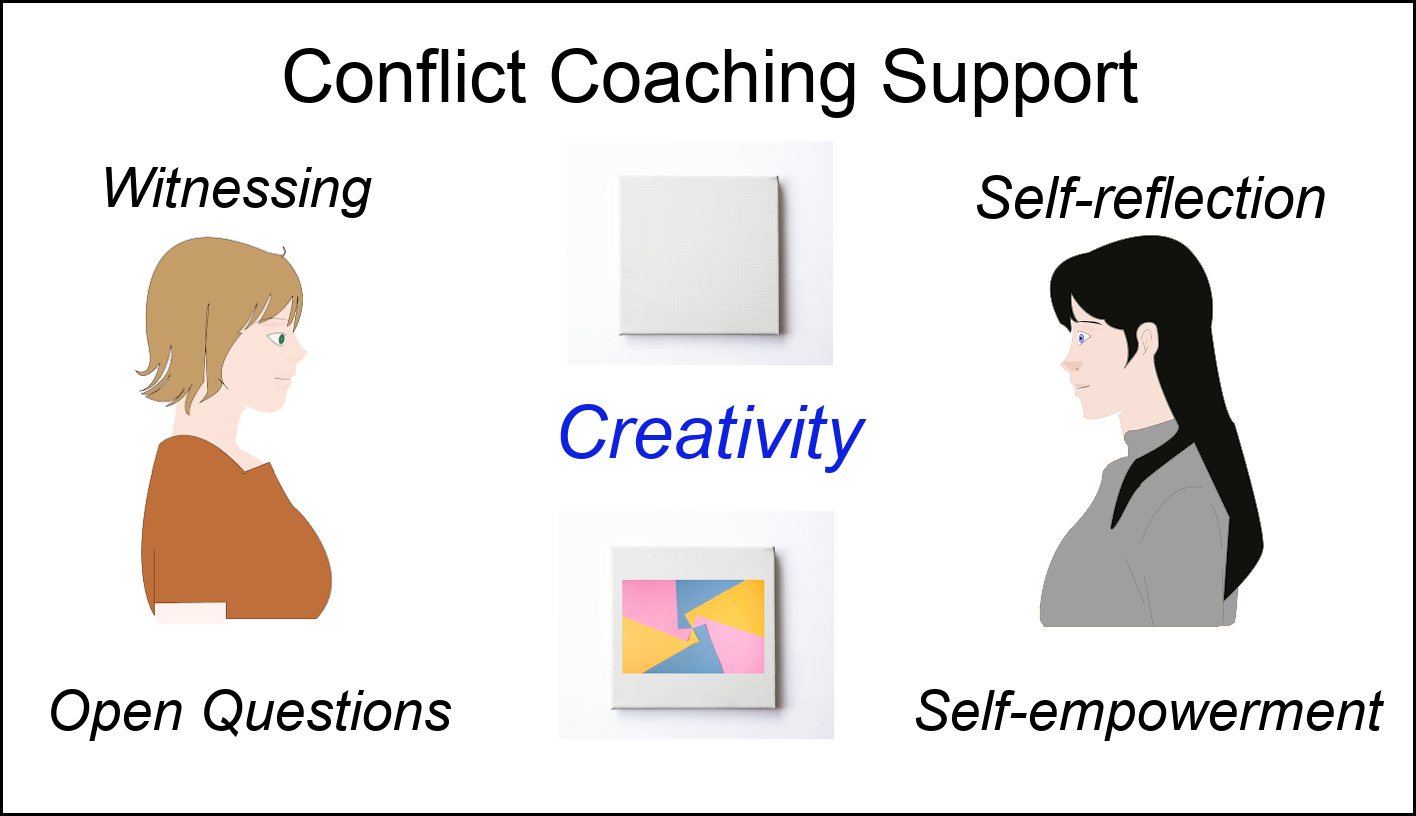
What is the purpose and focus of the CAOS Conflict Coaching Training Course?
In today’s world, many support processes have lost connection with the idea of being ‘client-led’, often because of the pressure of ‘targets’ to achieve particular outcomes that may not align with the needs and wishes of the clients themselves.
The CAOS Conflict Coaching model returns the power and decision-making within (and before) the coaching session to the clients and 'walks alongside' them in their exploration of their difficulty rather than try to lead them to a particular outcome or in a particular direction decided not by the client but by the coach.
It trusts that clients know what works best for them and what feels right to them and that having space to be listened to and assistance in being creative can often be all that's needed to help them 'clear the fog' that exists when caught up in an unresolved conflict, so that they can see how to create a way forward to something different and new that feels right for them.
Some questions to help you decide if you want to attend our Conflict Coaching Training Course:
- Could YOU be a Conflict Coach?
- Would it fit in your workplace to have someone that staff could go to for confidential support in maintaining effective workplace relationships even in the face of conflict and bullying allegations?
- And what about in your community? Are there difficulties happening between people - neighbour disputes, community group difficulties, housing co-operatives for example - who might find conflict coaching provides a useful 'space' in which to be listened to and helped to create a better way of dealing with those difficulties?
- Would a service that treats conflict as an opportunity for learning, change and growth rather than something to be suppressed or avoided be useful in your organisation? In your community?
- Do you work with families and young people and want skills that will help you and them to have difficult conversations about challenging subjects?
- Or would you want to offer Conflict Coaching on a freelance basis to a range of organisations and individuals?
Please Note: You do NOT have to be a Mediator to train to be a Conflict Coach. Our comprehensive course takes all attendees from start to finish through all aspects of the process whether they have past related experiences or not. Indeed many mediators who do the training say that it leads them to revisit their present approach and practices within that process.
But why is the CAOS course held over 5 days and not just one or two like many others?
Most conflict coaching courses are for mediators who wish to extend their repertoire of skills but the conflict coaching training is mostly focused on providing a further option for clients when a mediation they are involved in does not continue on to having a joint mediation meeting.
This is an entirely valid use of the process but is very limited in its scope. The CAOS model was designed from the start to be for people with individual conflict resolution challenges that may have no involvement at all with the mediation process. See examples in the video below of situations where this is the case.
The CAOS Model involves a lot more self-reflection and consideration of our own responses to conflict so that we are not at risk of simply projecting our ways of dealing with a situation on to clients when our approach may not be what works for clients and it is crucial that conflict coaching remains a client-led, person-centred approach, not one in which the coach 'diagnoses' the client in order to then 'apply' a 'treatment' to them based on the world view and subjectivities of the coach.
We see this as something that needs time to explore and some of our testimonials below will indicate how much attendees have appreciated that. Many shorter courses will focus on 'techniques' without having the time to consider the personal challenges any practitioner faces in working with other people's conflict challenges.
We also take more time in training coaches because a very important aspect of being a mediator or conflict coach is a requirement to be self-reflective and aware of our own challenges in relation to different conflict situations and if that is not a crucial part of a mediator or conflict coach's training it means that many practitioners simply end up giving advice and opinions 'in their own image' and so are then not much different to someone just 'sticking their oar' into a situation in a way that is uncomfortable for the client. The conflict coach needs to be someone who is able to maintain a safe space for others to speak about, reflect on and go on to create their own answers to a difficulty rather than receive a 'fix' from the mediator or conflict coach or even worse experience a 'battle' with them over their different views of how to go forward.
The latter does not represent an 'adult-adult' approach which is client-led and person-centred, it is more 'parent-child' and sees the client as a passive recipient of an answer or diagnosis or categorisation, with little opportunity for the client to create their own answers once this has occurred.
Finally, people who have trained as mediators can say 'I've trained as a mediator so can their be a shorter course, as I'll know a lot of it already'. As you will see from some of the testimonials, those mediators who proceed to the course find themselves very personally challenged to carry out the, in essence, simple practices of conflict coaching but when our own personal 'stuff' gets in the way we are not really helping people at all. This request also assumes that all models of mediation are the same and that is very much NOT the case.
This is why we say that you don't have to be a Mediator to train to be a conflict coach with CAOS as we literally start from scratch and don't assume that someone's prior role as a mediator will align with the conflict resolution support model that we have developed at CAOS.
What kinds of situations can conflict coaching help with? Watch this short video for examples.....
Some testimonials from attendees on our previous Conflict Coaching Training courses:
"The course has led me to rethink how I approach any conflict situation I personally face and conflict I am engaged to advise on. Thanks, this has been a life-changing course for me." Melloney Guiver - Solicitor, Mediator and HR Consultant (See Melloney's linkedin profile at this link)
"I would highly recommend this training course to anyone wishing to train as a Conflict Coach. For me this was more than just a training course. It involved much self reflection and open-mindedness and I felt inspired and energised throughout. What struck me most was the utter simplicity of the technique and then how very challenging that is to put into practice. I felt I was unlearning certain habits or methods I had previously used, as well as adding new skills to my tool box along the way.
Alan is an inspiring teacher. The way he runs the sessions is so natural and relaxed whilst at the same time packed with information, examples, exercises, discussion and challenges to yourself. If you're thinking about doing this training, just do it! You'll be pleased you did." Marcelle Samuels, HR Manager at Global Journey and now also a Conflict Coach.
"I found the experience of CC training truly transformative. I learned and developed new ideas, practices and philosophies. I explored the principles in depth and why they are such simple but fundamental tools to guide me as I go forward with my own practice as a conflict coach, but also in my own personal growth and development. We had a lot of fun with our learning along the way." - Andy Jones who completed our Conflict Coaching course in March 2022.
See more testimonials lower down
What Makes the CAOS Conflict Coaching Training Course Unique?

- Comprehensive 5-day Experiential Training: The course takes all attendees from start to finish through the model without any requirement for past experience in mediation or other personal support processes. Indeed many mediators who train with us say that it leads them to revisit their mediation skills and practices, as well as develop the skills to be a conflict coach, because of the unique approach to mediation from which the conflict coaching process developed.
- Rooted in Conflict Resolution Practice: The CAOS Model of Conflict Coaching is an approach rooted in the practice of mediation, and not an adaptation of life coaching or counselling. It is therefore focused on supporting clients in developing more effective communication and creativity in response to their conflict rather than setting goals or categorising the person as a particular ‘type’ and on that basis provide a 'prescription' or 'diagnosis' for how they should proceed.
- Short-term and Effective: Conflict Coaching is a 'step-in-step-out' process and therefore short term, like mediation, in that it trusts that every client has the capacity to resolve their own difficulty but may sometimes need a listening and creative 'space' in which to reflect on their present responses and develop new ways of responding to their difficulty. This helps clients to empower themselves through creating choices in how they deal with their conflict rather than remain stuck with a repeated reaction to their situation.
- Practical and Experiential - Not Academic and Didactic: CAOS Conflict Coaching training is experiential and focused on developing and improving the skills of listening, summarising and questioning that enable a client to reflect on and then create their own answers to their difficulty. It is not focused on developing an academic expertise in categorising clients through observation and interpretation of their behaviour in order to prescribe a 'fix'.
- A Genuinely Client-led Process: The CAOS Conflict Coach does not 'assess, diagnose and then prescribe' solutions to the client's conflict based on an academic theory learned elsewhere which may have little relation to the client's context. It trusts that the client is the expert in their own situation, knowing vastly more about it than the coach ever can and fully aware of their thoughts and feelings in relation to their situation. Conflict Coaching provides space to be listened to and supported in being creative towards developing a better way forward, and through this process the client ‘leads’ themselves to their best outcome.
- It has a history of practice: The CAOS Model of Conflict Coaching underpinned the first ever publicly available conflict coaching service in the UK when it was offered to London residents for free in 2009. The model was developed by Hillingdon Community Mediation and then developed further by CAOS Conflict Management when HCM closed in 2011 due to local authority funding cuts.
Our next Conflict Coaching Training Course is being held on:
Dates of next course:
Weds-Fri 28th-30th August 2024
and
Thurs/Fri 12th/13th September 2024
Please let us know if you would like to attend via the contact form below.
Our course is held at
at
Key House, 106, High Street,
Yiewsley, Middlesex, UB7 7BQ
(within London Oyster card area)
All days for this 5-day course are from 10.00am - 5.00pm.
Tea, coffee available from 9.30am
How much is it to attend the course?
£1150
Early booking discount rate of £1000
until 31st May 2024
Payment by instalments is possible if a non-refundable deposit of £500 is paid far enough ahead of the course to allow for this and final non-refundable balance payment is completed at least 2 weeks before the course starts. Please let us know when booking if you wish to propose an instalment payment option. The instalment option does not apply to any discounted rate being offered.
The course leads to the CAOS Conflict Coaching Practitioners Certificate and once trained you will have access to our free post-course Reflective Practice Support Sessions as a Member of our Learning Community of CAOS-trained Mediators and Conflict Coaches. (These are 2 hour sessions held monthly)
CAOS-trained Mediators have access to a place for a standard rate of £850.
Please contact us via the form lower down this page or call us on 020 3371 7507 to arrange booking of your place on the course.
Some more testimonials about the course...
"The delivery and pace of the information worked well for me. Also the opportunity to try things out and engage with everyone. I felt supported throughout the whole of the course by the trainer and also by the other participants." Anne Johnston, Support Services Manager,Shropshire Housing Alliance
"The relationships within the group worked well for me. I didn't feel rushed, there was a nice easy pace to the course and a lot of encouragement." Karena Ellis-Greenway, Green Chameleon Survey and Mediation Services.
"I have found the course totally absorbing and interesting on many levels. As a senior manager in a local authority there are many useful insights that I have gained about my own personal approaches to conflict. As a trained mediator the skills taught on the course have definitely enhanced my practice" - Tim Branson, Senior Social Work Manager, Bournemouth.
"I’m a teacher specialising in working with challenged and challenging young people. Over the past few months I have been getting good results from quietly putting into practice the underlying philosophies of CAOS in everyday interactions with students (rather than in explicitly conflict coaching sessions).
Many of the young people I deal with are vulnerable in various ways, and most have grown used to being the subject of interventions. The experience of being gently given ownership and empowerment can – once trust has developed – bring massive increases in how and what they communicate.
Impartiality and a no-blame approach add another dimension in building what to the young people can be novel working relationships. And consistently working towards an adult-to-adult dialogue, even with those in their early teens, can develop confidence and self-worth.
Students who were reluctant to engage, or who displayed inappropriate behaviour when given an opportunity to express themselves, have developed communication skills far beyond what others around them expected.
The conversational topics can be startling, too: the CAOS philosophies have supported me to develop dialogues about how young people feel after a violent outburst, what they really think about difficult relationships, or the actual roots of school refusal. I know that sometimes my colleagues can be uneasy about tackling such difficult conversations, but, as in a conflict coaching session, leaving the other person to lead the way is rarely risky and offers massive dividends." - Clive Osborne, Special Educational Needs/Disability Practitioner
How Do I Register My Interest In Conflict Coaching Training?
If you are interested in conflict coaching training - for yourself or for your organisation - please contact us on:
020 3371 7507
...or fill in this form:
CAOS Conflict Management is one of very few organisations in the UK that offers a comprehensive model of Conflict Coaching Training through which practitioners are given a philosophical and practical framework that informs their practice in every aspect of the process.
In its present 'early phase' of development as a process, most approaches to Conflict Coaching are extensions of life coaching or executive coaching which have a very different background to our model, which is rooted in the practice of mediation, a process specifically designed to support the resolution of conflict.
"I would definitely recommend the CAOS Conflict Coaching Training course to anyone who is interested in adding to their skillset and their own communication skills as well as training as a Conflict Coach. I found the course challenging on a personal level as well as from a professional perspective."
"The Trainer was excellent in his delivery of a very new subject and I feel confident that I have the knowledge to undertake the role of a Conflict Coach."
(See lower down the page for more testimonials)
Our past trainees are now drawing upon their Conflict Coaching training to support people in creating more effective ways of communicating and responding to conflict in the following areas:
- University students, for example difficulties in sharing accommodation.
- University staff, for example managers and team members having difficult working relationships.
- Carers and their families, for example difficulties between family members over how to care for a relative.
- Partners who have separated and are having difficulties relating to their ex-partner, particularly over issues related to their children.
- Managers - to help them become better leaders and be more able to support resolution of team member conflict more effectively.
Our training gives a clear set of Philosophies, Principles, skills and approaches for the trainee to draw upon as a foundation for their Conflict Coaching practice.

We provide post-course practice support for free as well as a personal web page, subject to certain reflective practice requirements being fulfilled. This can be used to refer clients to and publicise your practice.
"I have found the support sessions with Alan to be invaluable. I left both courses (conflict coaching and mediation) confident in my ability to practise the skills and principles.
However as I work a wide variety of cases, situations have arisen that I felt unsure about or that didn't turn out how I was expecting. Alan has been available to talk things through with. He embodies the principles and skills, asking open questions and listening in a way that allows me to question my assumptions and explore my perspectives on the issues I'm having. It's a relief! I always leave the support sessions feeling more confident in myself as a mediator, and clear on what I want to do differently.
I hugely appreciate this support - so many courses leave you without any follow up once you've done their initial training. I've also gained several new clients through the space I have on the CAOS website. Thank you!"
Jenny Owen
Mediator, Conflict Coach and Freelance Trainer, Co-ordinator of University College London Hospital Mediation Service (May 2022).
Where can I put my Conflict Coaching Training to use?
Conflict Coaching can be an extremely useful support option to offer people who are experiencing difficulties with unresolved conflict, as well as being a personally challenging practice.
Other areas in which the skills learned on the CAOS Conflict Coaching Training course can be used:
- Within the workplace by HR professionals and managers for supporting effective resolution of conflict by employees.
- With young people by youth workers and teachers and, of course, other young people on a peer-to-peer basis
- For staff within public bodies such as hospitals, local authorities, universities etc. to offer colleagues support on a confidential peer-to-peer basis.
- For parents or teachers wanting to find more effective ways of supporting young people with particular issues of unresolved conflict such as bullying, violence, school difficulties etc.
- For social workers who are aware of conflicts that can arise for their clients, and for themselves and colleagues with their clients.
- For people involved in difficult personal relationships, with a partner or ex-partner, or with siblings or other family members.
The range of potential applications for conflict coaching is extremely wide and should not be thought of as a service just for the work environment.
The History of CAOS Conflict Coaching
The CAOS Conflict Coaching Training course was developed out of a 2 year conflict coaching project in London UK in 2008, where individuals were offered free conflict coaching for any form of unresolved conflict that they were involved in.
The underlying philosophies behind the coaching were drawn from mediation, a process designed to promote creative thinking and effective communication to support the resolution of conflict. In this way it is different to other models of coaching that come from an executive or life-coaching model.
The CAOS model of Conflict Coaching focuses on supporting individuals involved in unresolved conflict to reflect on how they are communicating and responding to a conflict, relationship breakdown or other difficult situation and, where needed, create more effective ways of communicating and responding that work for them and the situation itself. As such it is a process that is suitable for anyone, in any context, as all of us experience unresolved conflict in our lives.
Conflict Coaching finally provides a means of support for dealing with unresolved conflicts as simply a problem for which someone is requesting help without it having to mean there's 'something wrong with them'.
It is frequently the case that people referred for support processes have to be pathologised or perhaps needing a categorisation as 'a victim' in the first instance in order for them to be offered support.
Conflict Coaching acknowledges that everyone can have a difficult relationship, communication difficulties or some other unresolved conflict and so is open to anyone who wishes to create change in a difficult situation they are experiencing.
Alan Sharland and colleagues who worked on the initial project had over decades of mediation experience and used their understanding of principles of effective communication and conflict resolution to develop a model for use in 1-to-1 situations.
The practices you will learn on the CAOS conflict coaching training course are applicable in any area of interpersonal conflict to support the individual client in creating more effective ways of responding to their difficulty.
Conflict Coaching recognises that communication and responding to conflict effectively can occasionally be difficult for any of us and is a skill we can pick up and learn to use for ourselves in order to reduce or remove those difficulties in our relationships at work, in our community and in our families.
Please click here if you'd like Conflict Coaching for yourself.
What do I learn on the CAOS Conflict Coaching Training Course?
The Conflict Coaching Training course content includes the following:
- Introduction to Conflict Coaching, its Underlying Philosophies and Principles of Effective Communication and Conflict Resolution.
- Developing the 'mindful' communication skills used in the CAOS model of Conflict Coaching.
- Developing self-reflection practices to support continuous learning as a Conflict Coach
- The 2 ineffective ways of approaching conflict and The '3 Cheers for Conflict' - which sees conflict as an opportunity for Learning, Connection and Insight.
- Acknowledging our own personal challenges as a Conflict Coach, learning how to grow from them.
- Keeping the 'expert' or 'Rescuer' out of our Conflict Coaching practice.
How Is The Training Delivered?
Our Conflict Coaching Training will challenge your own understanding and experience of conflict and how you respond to it.
Like mediation, conflict coaching is a discipline requiring continuous reflection and improvement if you are to effectively support clients in responding creatively to their unresolved conflicts.
The training is therefore experiential and interactive with frequent opportunities to practise coaching and then review the experience and realise learning points for incorporation into future practice.
There will also be a range of other activities in pairs and in groups to explore your role as a Conflict Coach, your own thoughts about and experiences of conflict, your attitudes towards clients, your own personal challenges in coaching clients and how you can meet those challenges.
Our conflict coaching training course is divided into an initial 3-day session followed by a 2-day session some weeks later and you will be encouraged to keep a reflective journal between the 2 sessions and if possible start to practise conflict coaching with clients.
We have an upper limit of 8 attendees on any course to ensure full opportunities for discussion and interaction as well as focused trainer support for attendees.
Some feedback from previous courses from Marina Sala at Choice Conflict Resolution, who completed our conflict coaching training course and now practises as a Conflict Coach:
What aspects of the course worked well for you? Why?
- The coaching practice
- Working with the Principles, through reflection, tableau and discussion and newspapers as it made me more aware of other principles I hadn’t considered in my own (and others) communication and thinking.
- The Principles themselves are very well thought out
- A more creative approach to C.C.
- The coaching done in a group setting. I learned a lot both as a client and as a coach in terms of asking questions, the impact closed or leading questions have and the impact of an incorrect summary.
- The clearing time, gave me a chance to arrive and gather before the day.
And this is what Gill Skelton said about our course:
I would definitely recommend the CAOS Conflict Coaching Training course to anyone who is interested in adding to their skillset and their own communication skills as well as training as a Conflict Coach.
I found the course challenging on a personal level as well as from a professional perspective.
It allowed for the possibility of exploring different approaches to communication which could also produce an unexpected outcome. This approach widened the possibility of outcomes in any form of communication beyond a fixed expectation.
Go with an open mind and be surprised!
Debbie Thomas, Assistant Regional Manager London for the Salvation Army (at time of training), said:
The Trainer was excellent in his delivery of a very new subject and I feel confident that I have the knowledge to undertake the role of a Conflict Coach.
Are you thinking 'What Is Conflict Coaching?' - then click here for an explanation of what conflict coaching involves so that you can decide if it's something you'd like to train in - or if you'd like to have conflict coaching.
What About After The Course?
We offer a free, monthly 2-hour Reflective Practice Support Session to all CAOS-trained Practitioners. These are held on different days and at different times each month to allow for different availabilities of different people to attend.
These sessions are held via zoom and are notified at least 2 months in advance via our practitioner newsletter.
If the conflict coaching training is bought in by an organisation, part of the package can include training in the running of ongoing support and review sessions or attendance at the regular sessions already being provided for other CAOS Conflict Coaches.
How Do I Register My Interest In Conflict Coaching Training?
If you are interested in training in this continuously growing field of conflict coaching, for yourself or for your organisation, please contact us on:
020 3371 7507
...or fill in this form:
Who Uses Conflict Coaching?
Conflict Coaching can be used by anyone involved in a workplace difficulty or a personal difficulty. We have provided it for staff at Universities and for individual members of the public with difficulties in their working or personal relationships, with their partners, work colleagues, children, parents, brothers, sisters.
Conflict Coaching can support anyone because it helps them to reflect on how they are communicating and how they are responding to their conflict irrespective of the context in which they are having difficulty.
We have provided conflict coaching training for staff at Brunel University so that they can provide it for other staff and for students at the university as well as for community mediation services so that they can extend the range of services they can offer to people in their community.
Leave Conflict Coaching Training page and return to Home Page
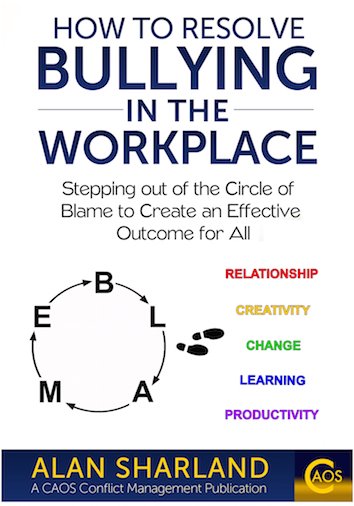

"Alan Sharland has written a vital book on bullying. His approach is the way forward. Instead of focusing on 'proving it', which takes us in the direction of investigations and hearings that go no where and only serve to exacerbate an already sensitive situation, he shows the way forward through direct communication and a focus on the behavior that is of concern."
John Ford - HR Mediation Academy
The CAOS Conflict Coaching Clients Handbook
Here's a Handbook to help you practise more effective communication and to review and improve how you are responding to unresolved conflict:
Buy Now for just £4! or click on the image to find out more.

Conflict Coaching from CAOS Conflict Management No Problem!
We can provide it via Zoom!
Please let us know you'd like your Conflict Coaching via Zoom when you complete a Conflict Coaching Request form.
Are you:
An employer wanting access to Conflict Coaching for your employees?
A service provider wanting access to Conflict Coaching for your clients?
A health professional wanting access to Conflict Coaching for your patients?
Please CONTACT CAOS if you have an enquiry about Conflict Coaching or our other services.
Train to be a Conflict Coach with CAOS Conflict Management. Courses for individuals and for organisations. Click the link above to find out more.
"Hello [Coach], Thank you so much for coming the other day. I immediately put some of the things into action. I feel so much happier since then, as if a weight has been lifted. The situation has improved no end. I do feel empowered. I hope other people can benefit as I have done .... Thanks again." - Conflict Coaching client
Conflict Coaching for Executives and Senior Managers
Conflict Coaching for Workplace Disputes
Conflict Coaching for Family Disputes
Conflict Coaching for Bullying
Conflict Coaching at Christmas "I'm writing to say THANK YOU VERY MUCH! for the Conflict Coaching sessions. I found them very helpful. It's helped me to realise though I continue to have difficulties that I can approach and look at them differently. And feel more empowered to face difficult situations."- Conflict Coaching client
Tel: 020 3371 7507
Would you like Conflict Coaching but you don't live in London?